ISO/IEC 42001
Build an AI management system an auditor can check
ISO/IEC 42001 is the international standard for governing AI responsibly. AIMS gives you the inventory, risk and impact assessments, Annex A controls and audit records the standard asks for.
The basics
What is ISO/IEC 42001?
ISO/IEC 42001:2023 specifies requirements for an artificial intelligence management system (AIMS): the policies, roles, processes and records an organisation uses to develop, provide or use AI responsibly.
It follows the same harmonised structure as ISO 27001 and ISO 9001, so it sits alongside an existing information security or quality management system. Clauses 4 to 10 are the management system requirements. Annex A lists the controls, and Annex B gives implementation guidance for each one.
It is a certifiable standard. An accredited certification body audits your management system and, if it conforms, issues a certificate valid for three years with annual surveillance audits.
2023
Published by ISO and IEC in December 2023
38
Annex A controls in nine domains
3 years
Certificate cycle, with annual surveillance audits
Requirements
Clauses 4 to 10, in plain language
These are the 'shall' requirements every certified organisation must meet, whatever controls it selects.
Clause 4
Context
Define the scope, the AI systems in it, your role and what interested parties expect.
Clause 5
Leadership
Top management commitment, an AI policy and clear roles and responsibilities.
Clause 6
Planning
AI risk assessment and treatment, AI system impact assessment, objectives and the Statement of Applicability.
Clause 7
Support
Resources, competence, awareness, communication and documented information.
Clause 8
Operation
Run the processes you planned, including risk treatment and impact assessments, and control changes.
Clause 9
Performance evaluation
Monitor and measure, run internal audits and hold management reviews.
Clause 10
Improvement
Handle nonconformities, take corrective action and improve continually.
Annex A
The 38 controls, by domain
You select the controls that apply to you and justify the choice in your Statement of Applicability.
| Domain | What it covers | Controls |
|---|---|---|
| A.2 Policies related to AI | AI policy, alignment with other policies, policy review | 3 |
| A.3 Internal organisation | AI roles and responsibilities, reporting of concerns | 2 |
| A.4 Resources for AI systems | Data, tooling, computing and human resources | 5 |
| A.5 Assessing impacts of AI systems | Impact assessment process and its effect on individuals and society | 4 |
| A.6 AI system life cycle | Responsible design, development, verification, deployment, monitoring and logs | 9 |
| A.7 Data for AI systems | Data acquisition, quality, provenance and preparation | 5 |
| A.8 Information for interested parties | User information, external reporting, incident communication | 4 |
| A.9 Use of AI systems | Processes, objectives and intended use for responsible use | 3 |
| A.10 Third-party and customer relationships | Allocating responsibilities, suppliers and customers | 3 |
| Total | 38 | |
Certification path
From first inventory to certificate
The order most organisations follow. AIMS supports every step up to the external audit.
- 01
Scope and inventory
Decide which parts of the organisation and which AI systems are in scope, and register them.
- 02
Gap analysis
Compare current practice against clauses 4–10 and Annex A to see what is missing.
- 03
Implement
Write the AI policy, run risk and impact assessments, implement controls and record evidence.
- 04
Internal audit and management review
Test the system yourselves and have leadership review results and objectives.
- 05
Certification audit
An accredited body runs a stage 1 documentation review and a stage 2 implementation audit.
ISO 42001 and the EU AI Act
One management system, two sets of requirements
The EU AI Act sets legal obligations for specific AI systems. ISO/IEC 42001 sets up the organisation-wide management system those obligations need: risk processes, documentation discipline, roles and continual improvement.
ISO/IEC 42001 is not a harmonised standard under the AI Act, so certification does not create a presumption of conformity. Teams that run both still save work, because the inventory, risk assessments and evidence are shared.
Read the EU AI Act guide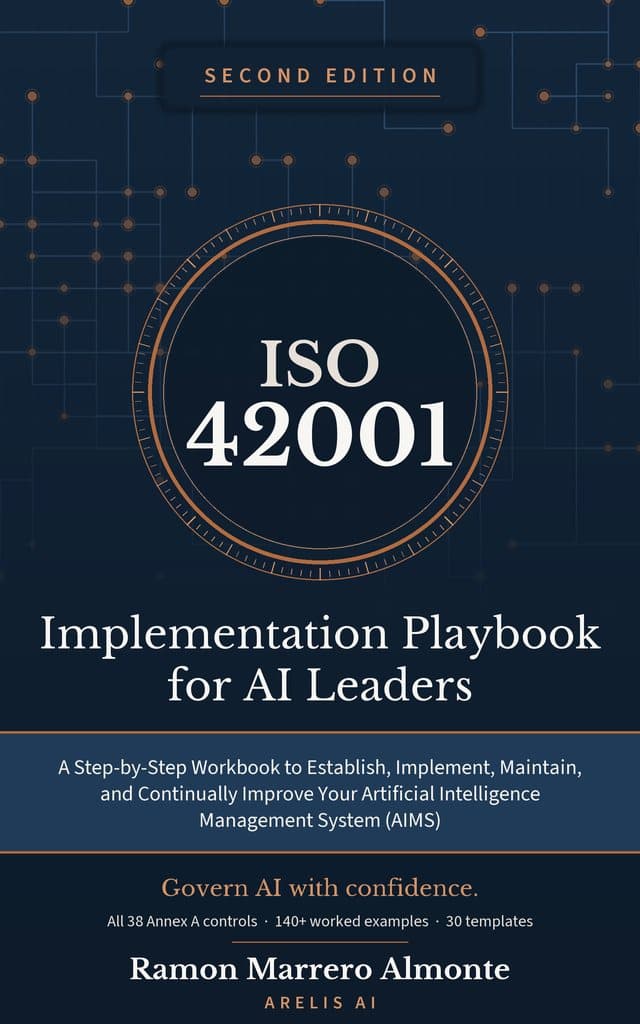
Free templates
Start with the templates from the playbook
30 editable templates for your AI management system, including the AI policy, risk register, impact assessment and Statement of Applicability, from Appendix A of the ISO 42001 Implementation Playbook for AI Leaders.
ISO 42001 FAQ
Is ISO/IEC 42001 mandatory?
How long does ISO 42001 certification take?
Do we need ISO 27001 first?
What is a Statement of Applicability?
Can Arelis certify us?
Plan your ISO 42001 implementation
See how AIMS maps clauses 4–10 and all 38 Annex A controls to owners and evidence, using your own scope.